How Classification Keys Took Shape in Natural History
Trace how classification keys moved from ordered descriptions to branching choices, and see how their printed forms helped readers identify organisms.
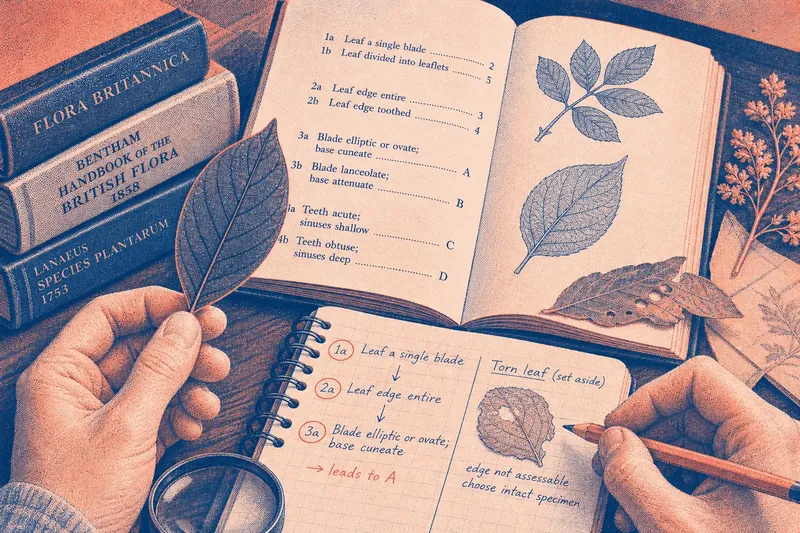
In a botanical manual, a reader reaches a pair of descriptions: one says a leaf is divided into leaflets; the other says it is a single blade. Choosing between them sends the reader toward a name. The classification key behind that small decision grew from a longer effort to make natural history searchable and usable.
Why did naturalists need routes to a name?
Early natural-history books gathered descriptions, names, and catalogues, but finding the right entry could mean comparing an unknown specimen with many pages. An ordered catalogue helped readers locate material; a description recorded what an organism looked like. Neither, by itself, offered a direct path from an observed feature to a likely identification.
Carl Linnaeus’s works helped establish systematic naming and description as central practices in natural history. Systema Naturae first appeared in 1735, and Species Plantarum followed in 1753. These books belong to the history of classification, but they should not be mistaken for the sole origin of identification keys.
The distinction matters: classification arranges organisms into groups, while identification asks which known description best fits a specimen. A key serves the second task. It can reflect a classification system, yet its immediate purpose is to guide a reader through observable choices.
How did classification keys develop in print?
Printed floras and manuals gave naturalists a practical setting for arranging descriptions so readers could identify organisms. One format presented paired statements, called a couplet. A reader compared the alternatives, followed the direction attached to the better match, and continued until reaching a name or description.
That structure did not emerge in one universally agreed moment, nor can it be assigned to a single inventor. Identification tools appeared in varied arrangements: some placed descriptive alternatives in ordered sequences, while others made the route through choices more explicit. Over time, numbered couplets and cross-references made the path easier to follow and revisit. The shift was not simply a new page design; it made the reader’s reasoning part of the book’s structure.
George Bentham’s Handbook of the British Flora, published in 1858, is one example of a nineteenth-century botanical manual organized to support identification through descriptions and analytical arrangements. It sits within a broader print culture of floras and teaching books, rather than marking a single decisive invention. Such manuals helped make structured identification a repeatable reading practice: inspect a trait, compare alternatives, and follow the stated route.
What changed when keys entered teaching?
In teaching, a key made observation visible as a sequence of decisions. Instead of only memorizing a list, a student could point to a feature, explain which description matched, and show where that choice led. Numbered couplets also left a route that someone else could inspect.
But each key reflects the organisms, terminology, and distinctions chosen by its author. A historical edition may use names or groupings that differ from a current course reference. That makes an old key valuable for studying how naturalists organized knowledge, though not automatically suitable for naming a specimen in a present-day assignment.
Why does the branching format endure?
A branching key divides a complex identification into smaller decisions. If a later choice conflicts with an earlier observation, the reader can revisit the route and see where uncertainty entered. The page records a chain of reasoning, not just a final label.
Digital keys retain that logic while offering different ways to move through choices. Some require a fixed sequence; others let readers begin with an observable feature they can readily inspect. Printed pages are easy to annotate, while digital formats can incorporate images or diagrams. Neither format solves a mismatch between the key’s scope and the specimen.
What questions help you read a classification key?
Does the key cover this specimen and region?
Compare the organisms and geographic area named by the key with the specimen’s context. If they match, continue; if they do not, select a source with a closer scope.
Can you observe the feature in the couplet?
Check whether the relevant part is visible and intact. If it is, compare it with both choices; if it is hidden or damaged, pause rather than guess.
What if both choices seem plausible?
Mark the couplet uncertain and review the observation or consult another suitable reference. If neither choice fits, the specimen may fall outside the key’s scope or the feature may be difficult to assess.
How should you handle unfamiliar terms or different names?
Use the key’s glossary or course materials to clarify terminology, then compare its names with the reference assigned for the task. If the sources differ, record the discrepancy and ask which reference governs the assignment.
How can a student trace one identification?
Imagine a student at Trường Đại học Khoa học Tự nhiên has one intact leaf and one torn leaf for a botany exercise. The key begins by contrasting a single blade with a leaf divided into leaflets. The student inspects the intact leaf, sees one continuous blade, and follows that choice. At the next couplet, the torn leaf’s edge is hard to assess, so the student sets it aside and checks the intact leaf instead. If its edge fits one description clearly, the student follows that branch; if not, the student records the route as unresolved and consults the course reference. The result is a traceable decision—or an explicit limit, rather than a forced name.
- Scope: Check the key’s named organisms and region. If both fit the specimen’s context, proceed; if either does not, choose a source with a closer scope.
- Visible traits: Check whether the feature requested by the couplet can be seen. If it is clear, compare it with both choices; if obscured, pause and seek an intact specimen or another usable feature.
- Contrasting choices: Check whether one statement fits better than the other. If one does, follow it; if both or neither fit, mark the couplet uncertain and consult another reference.
- Specimen condition: Check whether the relevant parts are intact. If they are, use them for the comparison; if damage hides a needed trait, set that specimen aside and use a better-preserved one when available.
- Terminology: Check unfamiliar words in the glossary or course materials. If the meaning is clear, continue; if it is not, resolve the term before selecting a branch.
- Edition and names: Check the key’s edition and compare its names with the assigned class reference. If they agree, record the identification; if they differ, note both and ask which source to use.
Memorizing every branch is not worth the effort. Learning recurring terms such as simple, compound, and opposite is more useful because those words help a reader interpret descriptions across different keys. The history of the classification key is also a history of making observations legible: a good identification route shows not only where a name came from, but where the evidence stopped being clear.