Reading Scientific Diagrams Without Misreading Their Symbols
Reading scientific diagrams gets easier when you sort symbols by function, trace connections, and record what a figure leaves unclear in your course notes.
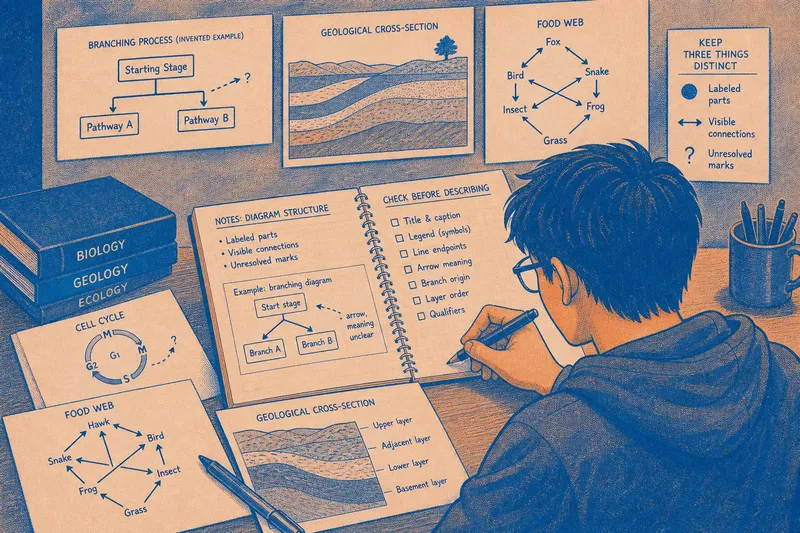
Reading scientific diagrams can feel straightforward until a red arrow points between two structures and you cannot tell whether it marks a route or simply identifies a feature. For biology or geology coursework at Trường Đại học Khoa học Tự nhiên, try following the diagram’s organization: where a sequence starts, which parts connect, and where one path branches.
That approach shifts attention from decoding every mark to tracing how the information is arranged. A cell-cycle diagram, a food web, and a geological cross-section organize relationships differently. Match your notes to the figure’s task, and keep your own additions visibly separate from the original.
How can you trace a diagram’s structure?
Start at the point the caption identifies, then follow the layout. In a process diagram, track the sequence from one labeled stage to the next. In a food web, follow each connector between named organisms. In a cross-section, read the labeled layers in their displayed order rather than treating the page as a map.
Make a spare sketch with boxes, names, and connecting lines. Keep the layout that carries the relationship; skip decorative shapes. If the arrangement is crowded, mark one path at a time so a crossing line does not become an accidental connection in your notes.
What should you record about branching and connections?
Record the endpoints of a connector and any label attached to it. For a branching process, note the shared starting point and the separate destinations. For a network, name the connected elements instead of relying on a line that may be hard to recognize later.
Arrows need special care because their shape alone does not settle their job. A caption may define an arrow as a direction, a pathway, or a pointer to a feature. If the figure leaves that open, write “arrow, meaning unclear” and do not build a process description around it.
How do you keep layers and sequences straight?
In a diagram with stacked layers, copy the labels in the order shown and preserve words such as “upper,” “lower,” or “adjacent” when they appear. Do not turn page position into a claim about age, depth, or cause unless the caption or course material supplies that relationship.
For a sequence, use the stage names and connecting marks to retain order. If the figure presents two branches, write them as separate paths. This simple layout prevents a note from collapsing distinct routes into one line of text.
What should you check before describing a diagram?
Check each feature below and make the stated choice from what you can actually observe.
Check the title and caption for the diagram’s subject. If they identify it, use that wording in your notes; if they do not, consult nearby course material before naming the subject.
Check the legend for colors and symbols. If a mark has a defined meaning, record it; if it has none, leave it undescribed or ask the instructor rather than guessing.
Check where each line begins and ends. If both endpoints are labeled, record the connection; if one endpoint is unclear, mark the link as unresolved and avoid adding it to a definite pathway.
Check arrowheads against the caption or key. If the figure defines their role, use that description; if it does not, call them unexplained arrows rather than assigning movement.
Check whether branches share a starting point or split from separate points. If they share one, note the common origin; if the drawing is too crowded to tell, separate the paths only after checking a clearer source.
Check layer labels and their displayed order. If the labels are readable, copy the order and any stated relation; if they are not, mark the sequence as unclear instead of inferring age or depth from placement.
Check for qualifiers such as “proposed,” “typical,” or “inferred.” If one appears, retain it in your description; if none appears, avoid adding certainty beyond the words and connections shown.
How would you turn a crowded figure into usable notes?
Say you have an invented biology slide with a labeled starting stage, two labeled branches, and an arrow whose meaning the caption does not explain. First, copy the starting-stage name and both branch labels into your notes. Next, draw one line from the starting stage to each branch, because those three labels and the split are visible. Then mark the arrow “meaning unclear” instead of using it to add a direction or sequence. Your resulting note preserves the stated branching while leaving the unexplained arrow out of the process description.
It is not worth redrawing every decorative detail or spending time matching colors that carry no stated role. A clean sketch of labeled parts and their connections is more useful than a polished copy that hides uncertainty.
What questions help when a diagram’s layout is confusing?
How do I tell which lines connect two parts?
Trace a line to both endpoints and check whether each reaches a labeled element. If the line disappears under another mark or stops without a clear endpoint, record the connection as uncertain rather than completing it from memory.
Does a branch always show a sequence splitting?
No; a branch may organize categories or routes without describing time. Use the caption and labels to decide whether the figure specifies a sequence, and otherwise describe the visible split without adding timing.
Can I infer layer order from where labels sit?
Only if the labels clearly identify the layers or the caption explains their arrangement. If label placement is ambiguous, copy the names without assigning a vertical order and consult the course material.
What should I do when two lines cross?
Check whether a junction, endpoint, or legend marks a connection at the crossing. If the figure gives no such cue, keep the lines separate in your sketch and note that their relationship is unclear.
When should you consult another view?
Use another source when your question concerns a feature the diagram does not make clear. A course caption may explain the intended pathway, while a labeled photograph or specimen view may help distinguish structures. Choose the source that addresses the missing relationship; do not assume that a different view will use the same layout or symbols.
For reading scientific diagrams, keep three things distinct in your notes: labeled parts, visible connections, and unresolved marks. That small separation makes a busy figure easier to revisit—and keeps your sketch from quietly turning a guess into part of the course material.