Field Sketch or Written Description: Two Ways to Record an Observation
Field sketch or written description: learn how to choose a record that preserves the details you will need when you return to an observation.
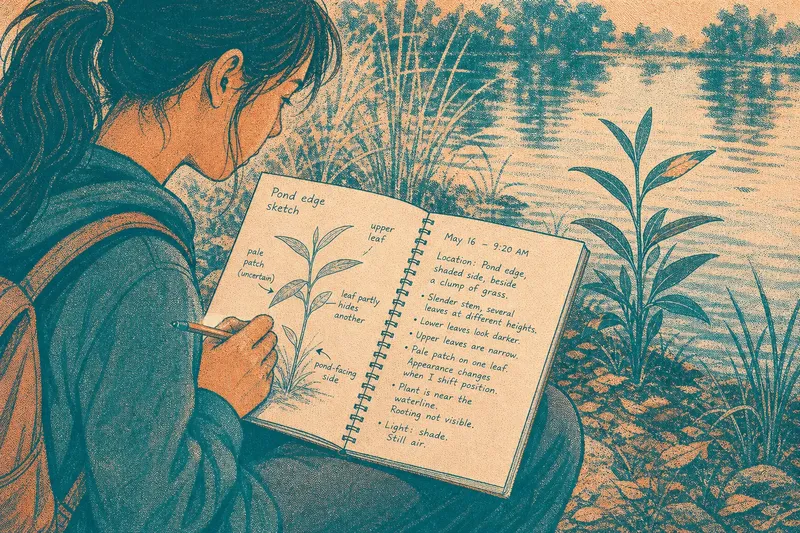
At the edge of a campus pond, a student notices a small plant leaning over the water, its leaves arranged in a pattern she has not seen before. She has a pencil, a notebook, and only a few quiet minutes before class. Should she draw it or describe it in words? For a field sketch or written description, the useful choice is the form that makes the details easiest to revisit—not the one that looks more impressive on the page.
What does each kind of record hold best?
A sketch keeps relationships visible at a glance. It can show how leaves attach to a stem, which parts overlap, where a mark appears, or how an object sits beside its surroundings. Even a spare outline can preserve a shape that is awkward to explain in a sentence.
Written description is better at details that need exact language: a surface that feels waxy, a color that shifts from green to brown, or a change noticed over time. Words can also distinguish what the observer saw from what they suspect. “Three narrow leaves emerge from the same point” reports an observation; “this must be a young aquatic species” moves toward interpretation.
Neither medium is a complete copy of an encounter. A drawing can omit texture and subtle color; a paragraph can leave the reader unsure about proportions or orientation. The decision is not which medium is scientifically superior. It is which medium preserves the feature that matters for the question at hand.
How does the pond observation unfold?
Imagine that the student is making an invented, hypothetical observation for a natural-science class. The starting point is a plant beside the pond, partly shaded by the bank. She can see a slender stem, several leaves at different heights, and a pale patch on one leaf, but she cannot tell from this view whether the patch is discoloration or reflected light.
She first writes a quick location note: “Pond edge, shaded side, beside a clump of grass.” Then she draws the stem and leaves as she sees them, adding a small arrow to show which side faces the water. She does not shade every surface or attempt a polished botanical plate; she marks the pale patch and the leaf that partly hides another.
Below the drawing, she adds a few sentences: the lower leaves look darker, the upper leaves are narrow, and the pale patch changes appearance when she shifts her position. She records that the plant is near the waterline, not that it is rooted in the water, because the base is hidden. The expected observable result is a page that lets her return later to the plant’s arrangement while remembering which detail remained uncertain.
The sketch carries spatial information; the writing carries conditions and limits. Together, they make it easier to compare the observation with a later view or a reference description without quietly turning a guess into a fact.
When is a field sketch the clearer choice?
Choose a sketch when the question depends on shape, position, or connections among parts. This often applies to a branching stem, a rock with layered bands, the outline of a leaf, or the placement of shells along a shore. A drawing can show whether features are opposite, alternating, clustered, or aligned without asking the reader to reconstruct the arrangement from prose.
Keep the drawing tied to what is visible. Use simple lines, arrows, and labels rather than decorative detail. If scale matters, include a familiar object or a scale bar only when you can do so responsibly; do not imply precise size from a quick drawing that has no basis for it.
A useful sketch need not be beautiful. It needs enough orientation and annotation for you to understand it after the memory of the scene has faded. A title such as “upper leaf, pond-facing side” may be more valuable than careful crosshatching.
When does a written description do more?
Use words when the defining observation is difficult to draw: a faint odor, a rough or slippery surface, a sound that comes and goes, or a sequence of changes. Verbal notes are also useful when the object is too large, moving, or partly obscured for a quick sketch to represent fairly.
Choose concrete terms and separate observation from inference. “The surface is dull and has fine ridges” is easier to revisit than “the surface looks strange.” If you are uncertain, say so plainly: “The edge may be torn or naturally uneven.” That small qualification keeps a later reader from treating uncertainty as a settled feature.
For colors, name what you can distinguish under the light you have, and note conditions that may affect appearance. “Dark green in shade” gives more context than an isolated color label. If a color is central to the question, a sketch can still help, but the words should carry the more precise description.
How should you choose a field sketch or written description?
What should I record first if time is short?
Write the date, place, and a brief subject label, then capture the feature most likely to matter later. A quick drawing can preserve arrangement, while one concise sentence can preserve a texture, color, or uncertainty that the drawing cannot show.
Can a field sketch be rough and still useful?
Yes, if its marks distinguish the important parts and the page identifies its orientation. Label uncertain or hidden features rather than filling them in from assumption.
How can I keep an observation separate from an explanation?
Describe what you directly saw before naming what you think it means. If an interpretation is useful, mark it as a possibility and keep it separate from the observation note.
When should I use both forms?
Use both when the subject has a meaningful spatial pattern and a defining quality that words express better. A small annotated drawing plus a few focused sentences is often more readable than either a crowded page of labels or a long paragraph describing every visible feature.
What should the finished page let you recover?
Read the page as if you had never seen the subject. Can you tell what was observed, where it was, which direction you were looking, and what remained uncertain? If not, add only the missing information. A date, location cue, orientation arrow, or short note about lighting can rescue an otherwise mysterious drawing.
For a sketch, check that labels point unambiguously to the right feature and that the main forms are not buried under annotations. For prose, check that each sentence names a visible or sensed detail rather than relying on “it” or “this” without a clear reference. These are small edits with a direct purpose: making the record usable later.
There is little value in spending a field session perfecting a drawing’s borders, lettering, or decorative shading while the important relationship remains unclear. Nor does a long description become more accurate simply because it is long. Keep the record lean enough to make the observation easy to find.
How can the record guide a later comparison?
When the student returns to the pond, she can look for the same arrangement and check whether the pale patch remains visible from another angle. Her notes also remind her that the plant’s base was hidden during the first observation. The page does not settle the plant’s identity; it gives her a fair point of comparison and a clear question to investigate next.
That is the practical test for a field sketch or written description: can it help you revisit what you noticed without making you more certain than the evidence allows? Choose the form around the detail you need to recover. If shape is the hard part, draw; if texture, change, or qualification is the hard part, write; if both matter, let each form do its own work.