A Quiet Hour with One Difficult Science Chapter
Use a quiet-hour reading routine to make a difficult science chapter manageable: set a pace, clarify key terms, explain each section, and leave with useful questions.
You have one quiet hour and a science chapter whose first page already feels dense. A quiet-hour reading routine can give that time a shape: preview the chapter, read for its main argument, pause to explain the hard parts, and finish with a short plan for what remains unclear.
The point is not to move through every line at the same speed. A chapter might combine technical terms, prose, equations, and evidence; each calls for a different kind of attention. Dividing the hour into purposeful blocks helps you make a decision when comprehension slips instead of rereading the same paragraph on autopilot.
How do you divide a quiet hour?
Use the clock as a guide, not a test. If the chapter is unusually dense, let a difficult section take longer and shorten the preview or wrap-up. The blocks below total an hour and give each part of the work a clear purpose.
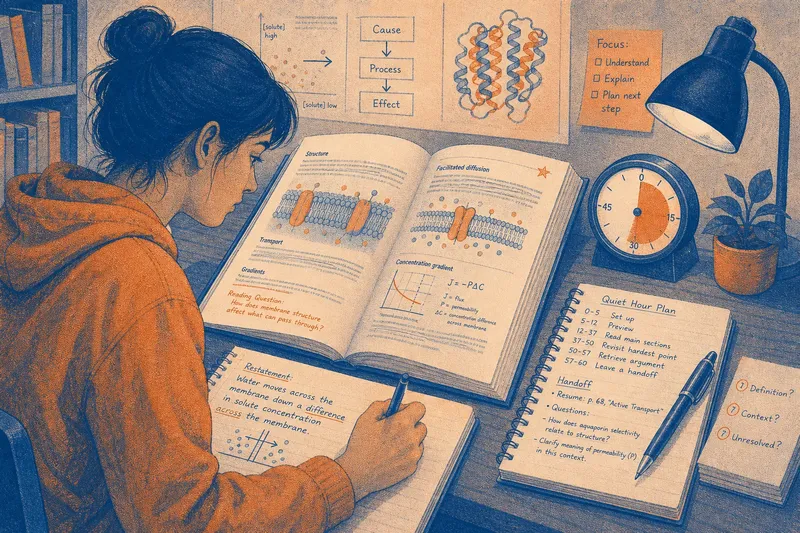
- Minutes 0–5: Set up. Put the assigned chapter, course notes, a pen, and paper within reach. Silence notifications, note the chapter title, and write one question you hope the reading will answer.
- Minutes 5–12: Preview. Scan the headings, opening paragraphs, learning objectives, and section summaries. Adjust your question if the chapter’s emphasis becomes clearer.
- Minutes 12–37: Read the main sections. Read at a steady pace. Mark only terms or claims that block your understanding; after each meaningful subsection, pause and write a brief restatement.
- Minutes 37–50: Revisit the hardest point. Choose the most consequential marked gap. Reread the relevant passage, check the chapter’s definitions or worked explanations, and revise your restatement.
- Minutes 50–57: Retrieve the argument. Close the book and answer your opening question in a few sentences. Reopen the chapter to check whether you missed an important condition or relationship.
- Minutes 57–60: Leave a handoff. Write the heading or page to resume from and list any question that needs an instructor, discussion section, or approved course resource.
Do not spend the setup block decorating notes or searching for a perfect study playlist. Those choices rarely clarify the chapter; a clear page, a pen, and a focused question are enough to begin.
What question should guide your first pass?
A broad title can hide the chapter’s actual problem. Before reading closely, look at the title, headings, opening paragraphs, learning objectives, and any summary. Ask whether the text is explaining a process, comparing classifications, or presenting evidence for a claim.
Write a tentative question in plain language. Say you are about to read a chapter on cell membranes. The headings mention structure, transport, and gradients, so you write, “How does membrane structure affect what can pass through?” That question gives the sections a shared direction without requiring you to know the answer yet.
Let the question change if the chapter points somewhere more specific. If a chapter that seems to be about enzymes turns out to focus on how conditions affect their activity, revise “What are enzymes?” to “How do conditions alter enzyme activity?” A useful reading question follows the text rather than forcing it into your first guess.
How do you handle unfamiliar terms without losing the thread?
Mark a word that interrupts comprehension with a circle, question mark, or brief cue such as “definition?” Then finish the sentence or paragraph before stopping. The surrounding explanation may show how the term functions, and a later section may define it directly.
After the paragraph, decide what kind of gap you have:
- Essential term: The next claim depends on the word. If the chapter or glossary defines it, write a short paraphrase; if not, add it to the questions for an approved course resource.
- Context-clued term: The text gives enough information to follow the argument. If you can explain its role in a few words, keep reading; if the next section depends on a more exact meaning, mark it for review.
- Unresolved term: The chapter leaves its meaning unclear or uses it in ways that seem different. If a course glossary settles the issue, check it; otherwise, record the specific sentence and ask for clarification.
Keep the term connected to the claim. If “gradient” describes movement, note what changes across the space and how the text relates that difference to the process. Copying a full glossary entry beside every mark is not worth the effort; a concise, course-appropriate paraphrase is easier to use when you return.
What should you do with a dense paragraph?
Finish the paragraph, then ask what it contributes: a definition, a sequence, a cause, a comparison, or a limit on a claim. Cover the text and restate that move in one or two sentences. If your version does not make clear what relates to what, reread only the relevant lines.
Imagine you reach a passage about water moving across a membrane. You first write, “Water moves because of concentration,” but notice that this leaves out the comparison across the membrane. You reread the passage and revise it to say that the text links water movement to a difference in solute concentration across the membrane. The revised sentence preserves the relationship the passage describes without adding an explanation the text did not give.
Keep essential scientific terms when replacing them with looser language would blur a distinction. If a paragraph will not yield to a short restatement, list its stages in the order given or draw a simple arrow between a stated cause and effect.
How should you read equations and other technical notation?
Equations can compress relationships into symbols, so connect each symbol to the explanation around it. Identify what each quantity represents in that context and note any stated condition. If the chapter provides a worked explanation, use it to trace how the relationship is applied; if a symbol remains undefined, mark that gap rather than guessing.
Do not turn every reading pause into a full problem set. If the chapter’s immediate purpose is to explain a concept, your first job is to describe what the notation expresses in words. Save a calculation for when the assigned material calls for one or when calculation is the point you cannot yet explain.
Which questions help you decide what to do next?
When should I reread a passage?
Reread when the unclear point is necessary to understand the next claim, such as a definition or a step in a process. If it is a detail that does not block the main argument, mark the location and continue.
Should I look up every unfamiliar word?
No. Use the sentence, nearby explanation, and course glossary first. If the claim depends on an exact meaning and the chapter does not clarify it, check an approved course resource or ask your instructor.
How can I tell whether I understand a section?
Cover the page and explain the section’s main point in your own words. If you can name the relationship or sequence and preserve its important conditions, continue; if not, revisit the specific passage that breaks the explanation.
What if my explanation sounds too simple?
Check whether it preserves the relationships and conditions in the original passage. Add a technical term or qualification if leaving it out changes the claim.
What should the last few minutes leave you with?
Close the book and answer your opening question without looking. Then compare your answer with the chapter: add a condition or relationship you missed, and mark the heading or page where the text explains it. Finish with a short list of questions phrased so you can act on them, such as “Which condition changes the direction of this process?” rather than “I don’t understand this section.”
Imagine you have been reading about rock formation and can recall “heat,” “pressure,” and “minerals” but cannot connect them. You check the subsection headings, return to the passage that describes the process, and write a sentence linking the terms in the order the chapter gives. Your handoff note names that heading and asks what role each condition plays. Next time, you can resume at the exact point where the explanation needs work instead of starting the chapter over.
A quiet-hour reading routine is most useful when it leaves a clear next move: an answer you can explain, a passage to revisit, or a question to take to class. Before you close the book, write that next move in a form specific enough that you will know where to begin.